
SUZUKI JIMNY 2O19:
INTRODUCTION:
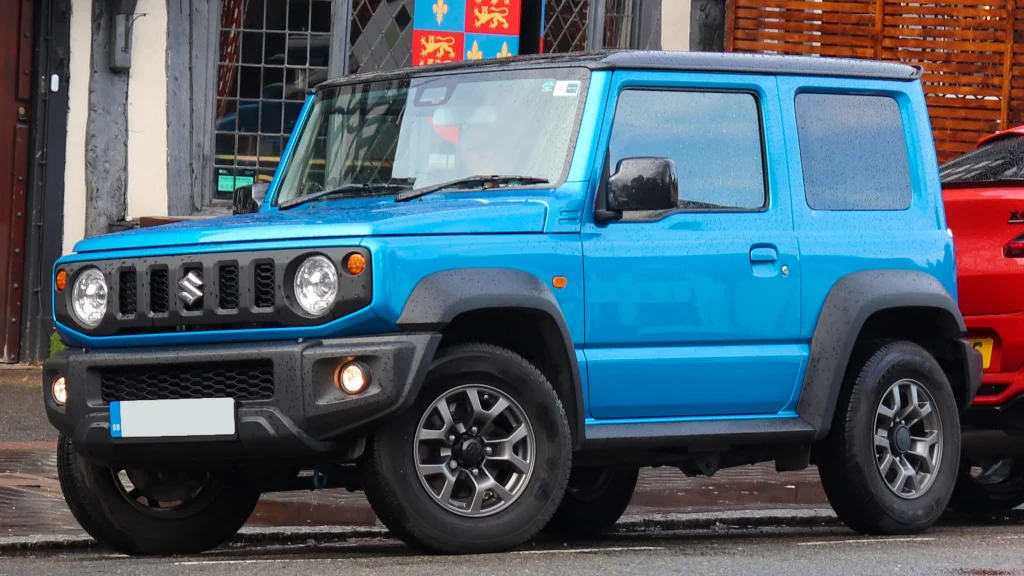
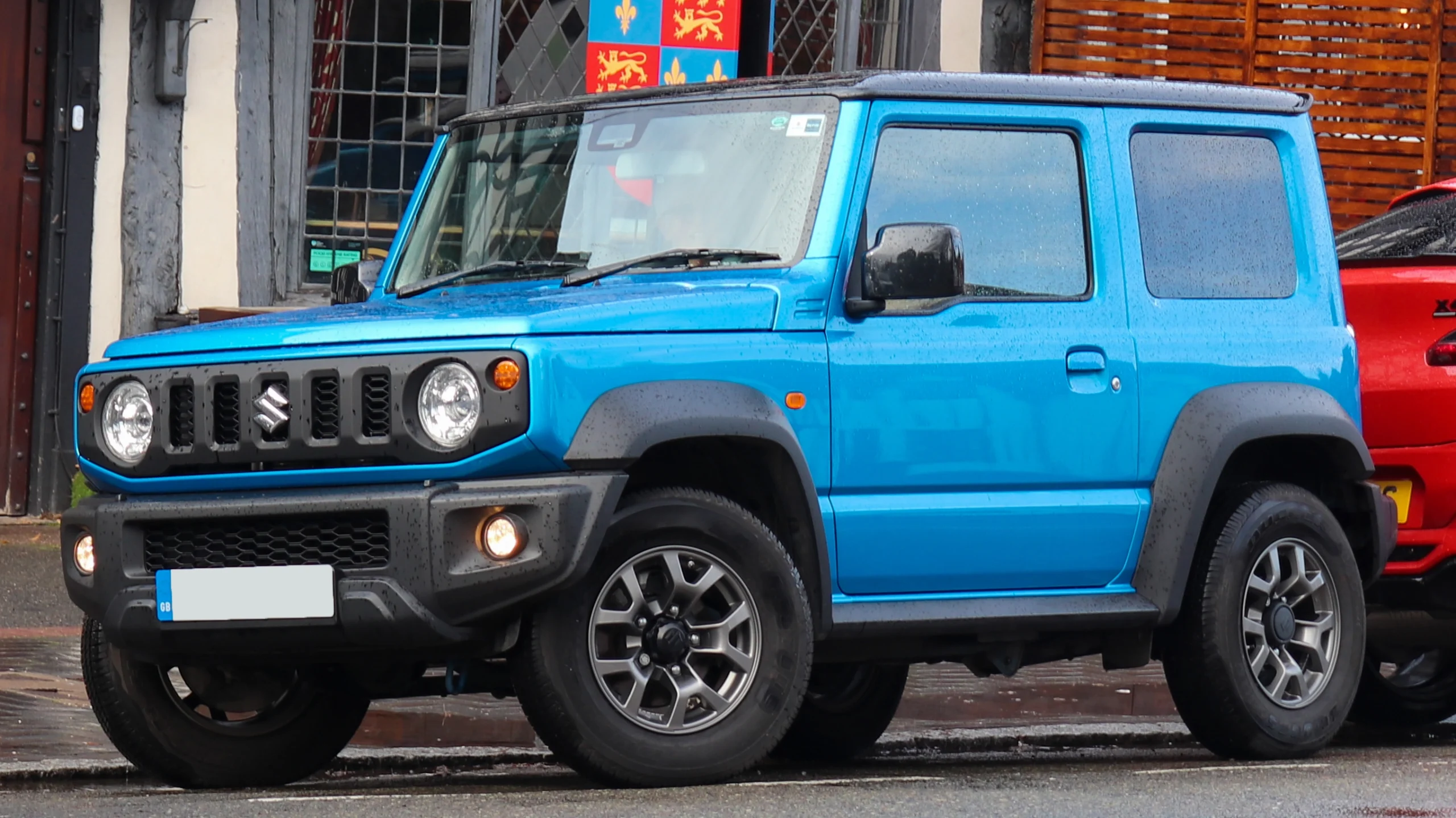
Modern blue Suzuki Jimny 4th generation parked on a wet urban street, showcasing its rugged boxy design and compact off-road build.
The Suzuki Jimny (Japanese: スズキ・ジムニー, Suzuki Jimunī) is a series of four-wheel drive off-road mini SUVs, manufactured and marketed by Japanese automaker Suzuki since 1970.
Originally belonging to the kei class, Japan’s light automobile tax/legal class, the company continues to market a kei-compliant version for the Japanese and global markets as the Jimny, as well as versions that exceed kei-class limitations. Suzuki has marketed 2.85 million Jimnys in 194 countries through September 2018.[1]
History
The history of Suzuki four-wheel drive cars began in the latter half of the 1960s, when Suzuki bought a Steyr-Puch Haflinger to study with the intent of building a kei-class off-road vehicle.[2] A better opportunity presented itself in 1968, when Suzuki was able to buy bankrupt Japanese automaker Hope Motor Company, which had introduced a small off-road vehicle called the HopeStar ON360. The tiny Hope company had been unable to enter series production, and only about 45 were manufactured.[2]
The first Suzuki-branded four-wheel drive, the LJ10 (Light Jeep 10), wasn’t introduced until 1970. The LJ10 had a Kei-class sized 359-cc, air cooled, two-stroke, in-line twin-cylinder engine. The liquid-cooled LJ20 was introduced in 1972 with the cooling updated due to newly enacted emission legislation, and it gained 3 hp. In 1975, Suzuki complemented the LJ20 with the LJ50, which had a larger, 539-cc, in-line three-cylinder engine – but still two-stroke – and it came with bigger differentials. This was originally targeted at the Australian market, but more exports soon followed.[3]
The Jimny 8 / LJ80 – updated from the LJ50, with an 800 cc, four-stroke, four-cylinder in-line engine, the final version of the original LJ series – was followed by the second generation Jimny 1000 / SJ410 (1.0 litre), and Jimny 1300 / SJ413 1.3 litre. An updated VERSION of the SJ413 became known as the Samurai and was the first Suzuki officially marketed in the US. The series from SJ410 to SJ413 was known as the Sierra in Australia, and remained the Jimny in some markets.
The third generation Jimny was released in 1998, and since then has acquired the same name in all markets. The 1998 release used the G13BB Suzuki G engine with electronic fuel injection (EFI), which was replaced by the M13AA EFI Suzuki M ENGINE in 2001 and the M13AA engine with variable valve timing in 2005, in conjunction with a minor interior redesign.
In late 2018, Suzuki launched an all new fourth generation Jimny, which was received with great enthusiasm by Jimny fans all over the world. For export, the engine displacement rose to 1.5 litre; and for the first time in history, the power output could exceed 100 PS (74 kW). Just like the second generation, the fourth Jimny is again available with a stretched wheelbase (34 cm / 13.4 in) – only this time, it has five doors.
Common design characteristics
Overall construction
All four Jimny generations have a separate body and frame, a (“ladder frame chassis”). The body is legally not a structural carrying part of the vehicle. Originally, It served only as a cabin to protect the occupants from the elements (but on early models not even that), provide comfort – and yet, on later models, it is strong enough to protect occupants in case of a crash. It is legal to own and drive on public roads and highways in the majority of countries in the world.
Suspension
All four Jimny generations have dependent suspension (solid-beam axles) both at the front and rear axles. This used to be a common suspension design for all-terrain vehicles up to 1990s, but has become a rarity in vehicle design in the 21st century. Dependent suspension is particularly well suited for all-terrain duty, both from the durability and performance perspectives.
The first two Jimny generations used leaf-sprung suspension at all four wheels, with the third and fourth generations using coil-sprung suspension at all four wheels. The late second-generation model called SJ800 Coily had coil-sprung suspension, as well.
Steering
All four Jimny generations have recirculating ball steering mechanism, which is particularly well suited for all-terrain duty, but relatively imprecise on-road compared to modern rack-and-pinion steering construction.
Transmission
All four Jimny generations have manually user-selectable part-time four-wheel drive (4WD) transmission, where the default (on-road) transmission MODE is two-wheel drive (rear-wheel drive). Rear-wheel drive can never be disengaged. The user, however, can (dis)engage the front-wheel drive (FWD) manually at any time under certain operating conditions. When FWD is also engaged, this provides 4WD.
Jimnys have no centre (interaxle) differential. This has a positive effect that at least two wheels, where each wheel is on a different axle, have to lose traction for the vehicle to lose traction when in 4WD transmission mode. However, the negative effect is that 4WD transmission mode must not be used on any surface not rather slippery, especially if having to steer. In other words, 4WD transmission mode should be used only on rather slippery surfaces, like snow, ice, mud, loose gravel, wet grass, and sand. Wet asphalt, wet concrete, and hard-packed gravel are not considered slippery enough.
All four Jimny generations have manually user-selectable dual-ratio (dual-range) gearing mechanism. The two ratios or ranges are called “high range” (for regular on-road driving and light to moderate all-terrain driving) and “low range” (for moderate to hard all-terrain driving and for all-terrain towing). The overall transmission gearing ratio is exactly halved when the vehicle is e to hard all-terrain driving and for all-terrain towing).
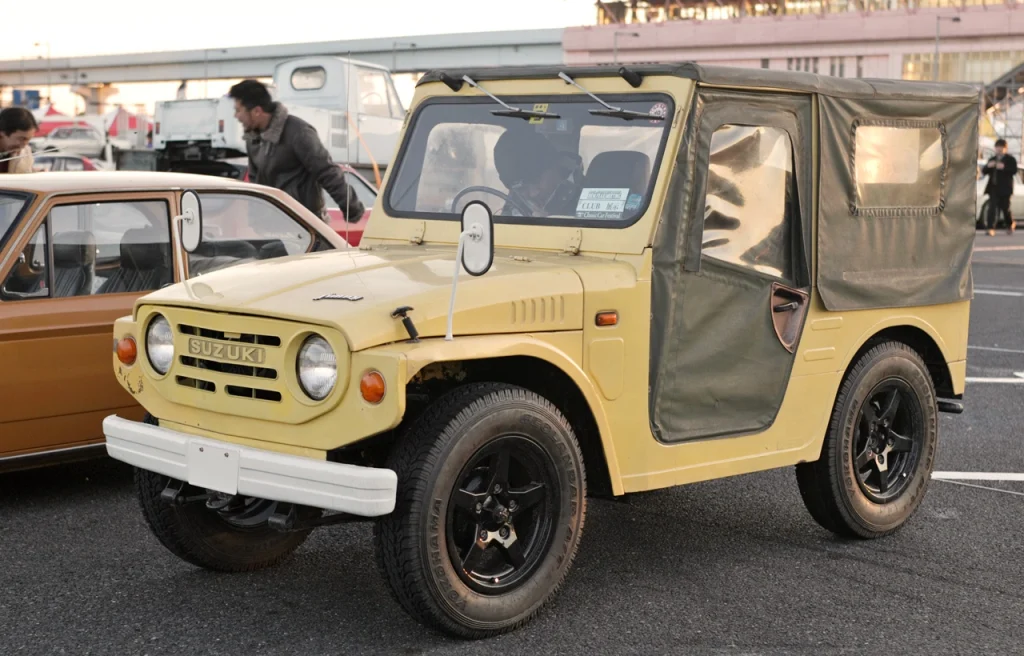
Vintage yellow Suzuki Jimny LJ10 with canvas soft-top, parked at a classic car meet — the original 1970s off-road mini SUV.
The overall transmission gearing ratio is exactly halved when the vehicle is in low range transmission mode. This has the effect of the vehicle moving about half as fast, but with double torque at the wheels in any transmission gear. For example, the fourth gear in low range behaves similar to the second gear in high range, and third gear in low range behaves similarly as “1.5th gear” in high range. The transmission gearing range is selectable only when the vehicle is in 4WD transmission mode. Therefore, low range cannot be used for on-road towing.
The (dis)engagement of 4WD transmission mode and the switch from one gearing range to another is performed by a dedicated transfer case mechanical unit, which is separate from the regular gear box unit. All four Jimny generations have a transfer case with an attached selection lever protruding in the cabin between the main gear box lever and the handbrake lever. The lever allows the user to select 2WD-H, 4WD-H or 4WD-L transmission modes at will. The only exceptions are later production years of third-generation Jimnys (more info in a dedicated chapter), which do not have a selection lever, but instead have servo-actuated mechanism to perform the same actions when invoked by the push of certain buttons in the cabin.
